![astro[sound]bites](https://fastfs1.podbean.com/themes/FrontRow/images/detail_banner_v1.jpg)
![astro[sound]bites](https://pbcdn1.podbean.com/imglogo/image-logo/6061460/logo_replacement.png)
Astrobites for your ears. Three grad students bring you cutting-edge research findings in astronomy and connect the dots between diverse subfields.
Episodes
Thursday Jun 20, 2024
Thursday Jun 20, 2024
In this week’s episode, we take a look at the hottest trend in dark matter candidates - Primordial Black Holes. They’re like black holes, only smaller (in some cases)! Join us as we see what all the fuss is about. Kiersten shares a story of a black hole playing video games inside a star and glitching out of the mainframe, while Shashank makes his a[s]b debut with an explosive transient conundrum that *might* explain the mystery of dark matter once and for all. We round off with a discussion about our favourite pet dark matter theories and the merits of direct experimental searches.
Astrobites:
https://astrobites.org/2024/05/29/noclip-on-simulated-primordial-black-holes-could-dance-through-sun-like-stars/
https://astrobites.org/2024/05/31/are-pbhs-detonating-white-dwarfs/
Astrobite Paper with Pretty Orbits:
https://arxiv.org/abs/2405.08113
Space Sound:
https://supernova.eso.org/news/releases/es2105/
Sunday Jun 16, 2024
Sunday Jun 16, 2024
We've reached a pivotal moment for astro[sound]bites: the podcast era where each of the original co-hosts has been replaced. Just like the Ship of Theseus, we ask: Is astro[sound]bites still the same show, even though all its original components have been replaced? We believe it is, and we’re excited about its continued evolution.
In this episode, we’re thrilled to introduce the three new astro[sound]bites co-hosts: Shashank, Cole, and Lucia. They'll be joining us in the next few months, and we’ll discuss what each is excited about for the future of the show. Stay tuned for an exciting new chapter as the new co-hosts take over steering the ship!
Tuesday Jun 04, 2024
Tuesday Jun 04, 2024
Episode 92: Beyond- Astronomy is a little Mental
Astronomy is hard! And in ways that extend far beyond the science we do every day. In this Beyond episode, Kiersten and Cormac talk all about mental health in astronomy and the structural issues that may be contributing to things like burnout and anxiety. It’s not all doom and gloom though. There are a few things that studies suggest that can help. We also chat about strategies that have helped us when we were struggling in hopes that they may be useful to you too. We round off with Cormac’s Hai-cool poetic riff for our one sentence summary.
Papers discussed:
https://arxiv.org/abs/2202.01768
https://www.nature.com/articles/nbt.4089
https://www.sciencedirect.com/science/article/abs/pii/S0048733317300422?via=ihub
https://comm.wayne.edu/files/keashly_spectra2015.pdf
Cormac’s shameless plug for the Early Career Astronomers’ session at the European Astronomical Society’s meeting:
https://eas.unige.ch/EAS2024/session.jsp?id=SS23
Crisis hotlines and remote support:
National Suicide Prevention Lifeline (US): +1-800-273-8255 (live chat also available on website; hearing-impaired TTY users can also dial 800-799-4889)
National Crisis Text Line: text/SMS HOME to 741741 for US; to 686868 for Canada; to 85258 for the UK
Crisis Services Canada: +1-833-456-4566 (text/SMS and live chat also available on website)
Samaritans (UK and Ireland): +44 116 123 (email also available on website)
The Trevor Project (US): +1-866-488-7386 (text/SMS and live chat also available on website; the lifeline will talk with any individual regardless of sexuality or gender)
Trans Lifeline: US: +1-877-565-8860; Canada: +1-877-330-6366
TelefonSeelSorge (Germany): 0800 / 111 0 111 or https://online.telefonseelsorge.de/index.php
Thursday May 23, 2024
Thursday May 23, 2024
91 is the atomic number of protactinium. Speaking of protracted, it’s finally time to say FareWill to Dr astroSaundbites himself, after five years of co-hosting our wonderful podcast. We begin with a deep dive into his Uranian adventures that might offer the key to our next mission there. We then reflect on his time in grad school, share some sage wisdom and explore what the future holds as he transitions to a not-postdoc at NASA.
Will’s first paper: https://ui.adsabs.harvard.edu/abs/2021AJ....161..280S/abstract
Will’s’ second paper: https://ui.adsabs.harvard.edu/abs/2022P%26SS..21305431S/abstract
Will’s third paper: https://ui.adsabs.harvard.edu/abs/2023PSJ.....4..199S/abstract
(Will’s fourth paper is in review - so stay tuned!)
Will’s career resource links:
Websites to help you discover lots of careers you can pursue with your PhD and how to get there:
https://beyondprof.com/
https://theprofessorisin.com/
https://myidp.sciencecareers.org/?AspxAutoDetectCookieSupport=1
https://gradfutures.princeton.edu/
A great webinar on career transitions for astronomers:
https://www.youtube.com/watch?v=OX3aUONcLP0&ab_channel=AAS
Great books:
https://kansaspress.ku.edu/9780700626885/
https://theprofessorisin.com/buy-the-book/
Sunday Apr 28, 2024
Sunday Apr 28, 2024
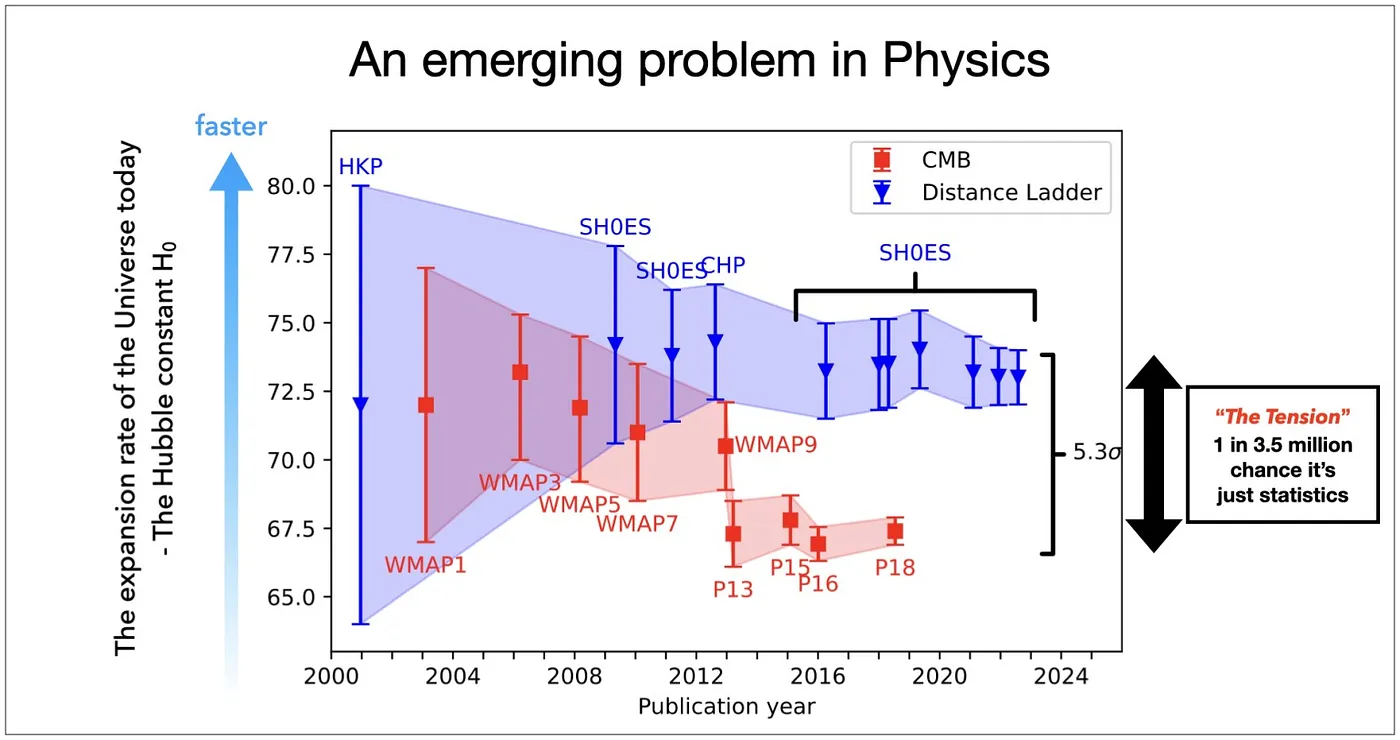
How fast is the universe expanding? It turns out this important value, the Hubble constant (H0), is under constant debate. The two main teams have numbers that disagree by over 5 standard deviations! Today on a[s]b, we resolve the Hubble tension once and for all, as Cormac and Kiersten square off in the Great H0 Debate. Cormac comes in with feist and facts while Kiersten engages with rebuttal and reason. In the end, there can only be 1 winner, and that’s for you to decide! Vote here for the winner of the debate, what the true value of H0 should be, and what we got wrong in the episode (we tried our best!). https://forms.gle/3dybtrhysS9Lvia37
Timeline of the Hubble tension: https://miro.medium.com/v2/resize:fit:1400/format:webp/1*oekTYTkZQmw7DxzUaLqDVw.png
Astrobites used for this episode:
https://astrobites.org/2020/05/12/magnets-and-hubble/
https://astrobites.org/2021/04/01/south-polarization/
https://astrobites.org/2023/03/29/multi-messenger-constraints-on-the-hubble-constant/
https://astrobites.org/2024/04/16/sn_h0pe/
Space sound: https://www.system-sounds.com/earth-day/. Credit: SYSTEM Sounds/Matt Russo/Andrew Santaguida
Article by Subir Sarkhar: https://inference-review.com/article/heart-of-darkness
Cool Wikipedia page Will references: https://en.wikipedia.org/wiki/Numeral_prefix
Chart Kiersten references: https://en.wikipedia.org/wiki/Cosmic_distance_ladder#/media/File:Extragalactic_Distance_Ladder_en.svg

Tuesday Apr 16, 2024
Tuesday Apr 16, 2024
In this episode, we hear about Kiersten and Will’s epic adventures in both hemispheres! Both Kiersten and Will watched the eclipse that passed through North America on April 8, 2024 and are still buzzing with excitement. Kiersten tells us about a recent paper that explores why planets might act so indecisive about sitting between being a super-Earth or mini-Neptune. Will’s astrobite describes a similarly chaotic exoplanetary tale about a very slow moving planet which “came in like a wrecking ball” and “never hit habitability so hard” (everything in quotations must be sung in Miley Cyrus’ singing voice). All in all, we all share a laugh and an emotionally charged episode!
Kiersten’s astrobite: https://astrobites.org/2024/03/28/template-post-22/
Will’s astrobite: https://astrobites.org/2024/03/06/exoplanet-hr-5183-b/
Eclipse XKCD: https://www.explainxkcd.com/wiki/index.php/2914:_Eclipse_Coolness
Eclipse Astronomy Photo of the Day: https://apod.nasa.gov/apod/ap240409.html
Sonification: https://www.youtube.com/watch?v=8al9FRz-VKY
Sonification description: https://www.exploratorium.edu/eclipse/listen-eclipse
Miley Cyrus’ “Wrecking Ball” music video: https://www.youtube.com/watch?v=My2FRPA3Gf8
Saturday Mar 30, 2024
Saturday Mar 30, 2024
In celebration of the a-bit-over-a-week after St. Patrick’s (definitely not Patty’s) Day, we bring you another Ireland-related episode. Due to historically unsupported stereotypes about the Irish being lucky, we bring you two astrobites busting with cosmic coincidences and a dash of luck. Kiersten tells about a plucky planet that avoided a hangry host star, while Will brings us yet another binary black hole bonanza. Cormac shares a bit of an infamous Irish space sound that you could call cosmic comic relief. In the spirit of luck, we talk about the role of luck in our own journeys to space and in the field of astronomy as a whole.
This week’s “space sound” - https://www.tiktok.com/@ladbibleireland/video/7278649311334780192?lang=en
Sunday Mar 17, 2024
Sunday Mar 17, 2024
In celebration of St. Patrick’s (not Patty’s) Day, we share a super short sneak peek at next week’s episode, featuring fun Irish astronomical facts. We’re calling it the Shamrock Shake-up! In addition to the astronomical facts, Will takes us on a journey to the past with some wild Irish lore of his own! We hope you enjoy what might be our first “Beyond the beyond” episode, and Lá Fhéile Pádraig faoi mhaise daoibh go léir!
Intro music excerpt: “Granny hold the candle while I shave the chicken’s lip” - Bodega
Sunday Mar 10, 2024
Sunday Mar 10, 2024
We talk about gravitational waves again, but this time, in ways you wouldn’t expect. Cormac tells us how you could use gravitational waves to study the interior of the Sun, if the alignment is just right. Sabrina explores whether gravitational waves could be detected by Earth’s magnetosphere through the Gertsenshtein effect. Simultaneously, we learn that Sabrina knows how to pronounce Russian names properly and Will isn’t the biggest fan of theory.
Astrobites:
https://astrobites.org/2023/06/20/using-planetary-magnetospheres-to-detect-gravitational-waves/
https://astrobites.org/2023/11/11/using-gravitational-waves-to-peer-inside-of-the-sun/
Additional thematic material:
https://astrobites.org/2023/02/08/detecting-gravitational-waves-with-the-moon/
https://astrobites.org/2022/12/22/gravitational-wave-parallax/
https://www.sciencedirect.com/science/article/pii/S0273117723009171?via%3Dihub
Space sound: https://www.nasa.gov/solar-system/sounds-of-the-sun/
Ultra-high-frequency gravitational wave conference: https://www.ctc.cam.ac.uk/activities/UHF-GW.php
Friday Feb 23, 2024
Friday Feb 23, 2024
In the second episode of the astro[sound]bites series focusing on Indigenous astronomy, we interview Duane Hamacher, a physics professor at the University of Melbourne and a world leading researcher in Indigenous astronomy. Duane shares his journey from Missouri to pursuing a PhD in Australia and immersing himself in the study of astronomy within the Torres Strait community, learning from Indigenous knowledge holders. He tells us how Indigenous peoples around the world have seen astronomy more as a way of life that’s embedded in their culture. Through our discussion, we challenge common misconceptions and gain insight into the profound significance that Indigenous astronomy has held for humanity, long preceding the invention of telescopes. However, our interview only scratches the surface of the field of Indigenous astronomy.
Thank you to Prof. Duane Hamacher for taking the time to be interviewed for this episode! (Also sorry for the construction noise in the background of this episode! We hope the exciting interview makes up for it.)
Duanes’ book The First Astronomers: https://www.thefirstastronomers.com/